


A Silent Shift in the Middle East: the Saudi-Pakistani Mutual Defense Pact
Imaad Nasir,
London, UK
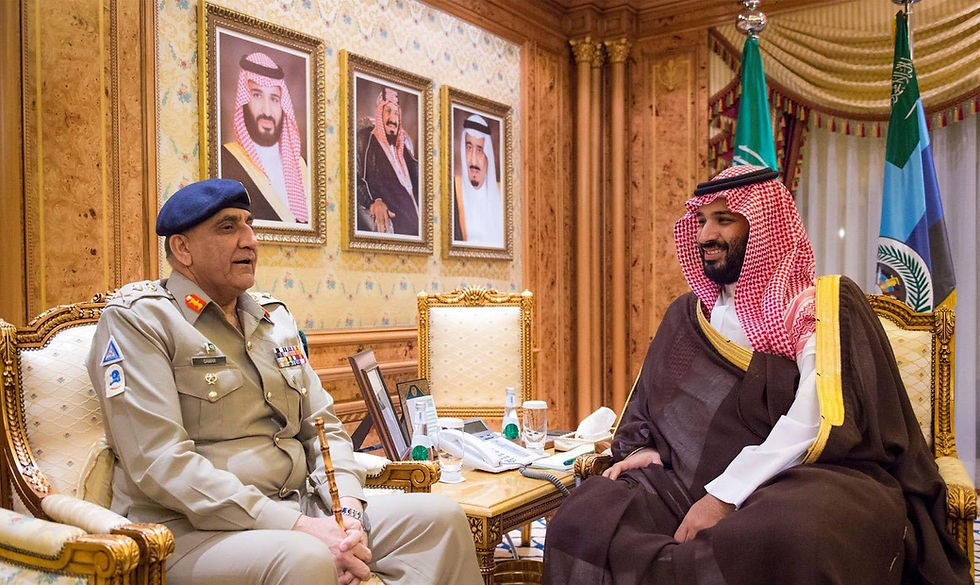
On 17 September 2025, a relatively discreet development took place for an attention-consuming Middle East, yet it had remarkable implications for the geopolitical balance in the world’s foremost hotspot for conflict. In Riyadh, PM Shehbaz Sharif and Crown Prince Mohammad Bin Salman signed the Saudi-Pakistani Strategic Mutual Defense Agreement, binding the two nations closer than ever before and requiring them to come to each other’s aid in war.
The Past
In one way, this new pact is relatively unsurprising. For decades, the most militarily powerful (Pakistan) and the wealthiest (Saudi Arabia) Muslim-majority states have co-operated closely in defense. To the tune of $1 billion, Saudi Arabia bankrolled Pakistan’s nuclear development program, which culminated in Pakistan becoming the first Muslim nuclear power in 1998. And since the 1960s, Pakistan has trained the Saudi army and even stationed 11000 troops there during the Gulf War.
Yet, given the short-term context of the Saudi-Pakistani alliance, the development shocked many observers. For years, the relationship between the two states has waned. This has not been driven by a single decision by either government to degrade their partnership, but by a coincidence of events and a steady drifting apart. Saudi Arabia’s meteoric rise in recent years has been matched with Pakistan’s decline and its persistent economic crises. The Saudi government has increasingly valued a strong relationship with Pakistan’s arch-rival India — a bedrock for attracting Indian labour to fuel the diversification of the Saudi economy away from oil.
Then, in 2019, New Delhi removed the special autonomy enjoyed by the Muslim-majority region of Jammu and Kashmir (disputed with Pakistan) and instituted a year-long communications blackout. At the time, Pakistan was led by Imran Khan, whose populist party, the PTI, prioritised a hawkish foreign policy stance. Khan’s government staunchly criticised the Saudi unwillingness to oppose India’s actions. Riyadh responded with a not-so-gentle reminder of its leverage over the Pakistani economy: Islamabad was forced to return $1 billion of a loan it had received from the Saudis.
Thus, given the context, this new pact seems to reflect a surprising shift in the Saudi-Pakistani relationship. However, there remains a fundamental difference between this rosy period of friendship and previous ones. Whilst the last era of Saudi-Pakistani rapprochement was built on a sense of postcolonial Muslim brotherhood, the new era is a pragmatic one, driven by self-interest. For Pakistan, the recent conflict in May between it and India (where the two sides engaged in cyber attacks, dogfights in the sky, shelling and drone attacks) has reinforced its need to counter New Delhi on the diplomatic front. Riyadh makes a natural partner, doubling not just as a counter against India but also as an investor, propping up Pakistan’s ailing economy. For Saudi Arabia, meanwhile, two changes have pushed it to seek new security partners: Israel’s September attack on Doha, and the unreliability of the US under Donald Trump as a security guarantor.
The Present
Evaluation of the new Mutual Defense Pact has been limited by one fact: the contents of the agreement have not been published. It is thus unclear as to who has truly gained the most from the Mutual Defense Pact. Islamabad will likely be the greatest victor if the definition of aggression (for which mutual defense is invoked) is as broad as possible, encompassing even small provocations or targeted attacks. This is because since its humiliation in the land-based 1999 Kargil Conflict, Pakistan has largely abandoned conventional conflict with India and instead aimed to score victories in the air and in small confrontations. Meanwhile, on its western frontier, Pakistan often engages in minor confrontations with Afghan forces along the porous Durand Line (the Afghanistan-Pakistan border). If these sorts of engagements would be enough to require Saudi Arabia to come to Pakistan’s aid, that would seriously limit Kabul or New Delhi’s appetite to engage in them in the first place.
It seems, however, that this broad definition of aggression is unlikely to have been used in the agreement. Instead, Riyadh would probably have insisted upon a more limited set of circumstances in which they would be required to come to Pakistan’s aid - in order to avoid conflict with India or Afghanistan. This scenario is especially likely given that recent confrontations between Afghanistan and Pakistan (in which Afghanistan claimed to kill 50 Pakistani soldiers and Pakistan more than 200 Taliban fighters) yielded a neutral response from Saudi Arabia, with Riyadh insisting upon mutual restraint rather than supporting Islamabad.
Additionally, it is Riyadh that gains the most from a pact based purely around defence, as this one is. Given the asymmetry between the strength of the Saudi and Pakistani militaries, Saudi Arabia gains much more (particularly by falling under Pakistan’s nuclear umbrella) from Pakistan’s army than Pakistan does from Saudi Arabia’s. By contrast, had the Agreement been wider- ranging, requiring Saudi Arabia to fund a proportion of Pakistan’s military, or invest in the Pakistani economy, the benefits received by Islamabad might have more closely matched those won by Riyadh. But without this, between the two parties to the deal, it seems that Saudi Arabia has emerged the most advantaged.
Within Pakistan, the Mutual Defense Pact marks the return of establishment forces to unchecked dominance in the country. Under Imran Khan’s relatively brief four-year populist governance, Pakistan’s foreign policy shifted decidedly away from the United States and Saudi Arabia, towards China and Afghanistan, and against India. Following his removal from power in 2022, the return of establishment military-backed political parties redirected Pakistan to a less aggressive foreign policy. In particular, the Saudi-Pakistani deal marks the dominance once again of the all-powerful Sharif political family in Pakistan. The Sharifs — leading their socially conservative, investment-friendly party, the Pakistan Muslim League — are closely aligned to Saudi Arabia, with Riyadh saving former PM Nawaz Sharif (brother of PM Shehbaz) from imprisonment following his overthrow in a 1999 coup.
For other regional players, the Saudi-Pakistani deal also brings serious consequences. New Delhi will likely be brooding after a year of diplomatic setbacks — first with the lack of a decisive victory in its May clash with Pakistan, then with punitive tariffs imposed on it by the US — with the Mutual Defense Pact reinforcing this attitude. However, India will be unlikely to consider the Pact as a serious military threat since Saudi Arabia remains unlikely to intervene in an Indo-Pakistani conflict.
The agreement also seems to respond to Israel’s assertiveness in attacking other Middle Eastern countries (having struck Lebanon, Syria, Qatar, Iran and Yemen during the Gaza War). However, Israel is similarly unlikely to worry about the pact. This is because Israel would regardless almost never attack Saudi Arabia, being guaranteed to unleash the wrath of the US if they were to do so. Nevertheless, West Jerusalem might consider the pact a sign that its attacks could only repel Arab states into the hands of Pakistan and China, threatening Israel’s normalisation attempts with Arab states; and damaging the US’ position in the region.
Indeed, quietly content from the Mutual Defense Pact will be Beijing, who will see it as a weakening of Washington’s regional influence. For years, China has been courting Saudi Arabia and the UAE in an attempt to grow its Belt and Road Initiative, secure a strong relationship with rising global powerhouses, and maintain a source of oil for itself. Through the conclusion of this pact, Pakistan — one of China’s closest partners — has acted as an intermediary in pulling Saudi Arabia away from American orbit.
The Future
In response to the pact, some have proposed that the Saudi-Pakistani Pact might morph into an ‘Islamic NATO,’ expanding to include other Muslim states. If this were to happen, the Pact would become a counter solely to Israeli actions in the Middle East, rather than a counter to both Israeli and Indian actions. This is because the ‘Islamic NATO’ would almost certainly be dominated by the wealthy and influential Gulf Arab monarchies, all of whom maintain close ties with India. Without the support of these other members against India, Saudi Arabia would also have a stronger excuse not to participate in action against New Delhi. In that case, the ‘Islamic NATO’ would fail to deter Indian aggression against Pakistan and its focus would solely be on Israel.
The question of whether Iran would participate in this expanded pact is one of utmost importance. If it were to, the alliance would further splinter ideologically (given the long-standing regional tensions between Saudi Arabia and Iran) but be united even more by an anti-Israeli position. The alliance would also increasingly be seen as a Chinese-leaning and anti-American one, given that two of the three principal powers within it (Pakistan and Iran) would be strongly aligned with Beijing. This could mark the culmination of Beijing’s efforts to become the foremost foreign influence in South Asia and the Middle East.
However, it remains to be seen whether either Pakistan or Saudi Arabia would support serious expansion of the pact. For Pakistan, every added member reduces the power of its voice within the group; reduces the credibility of its deterrence against India; and increases the risk of it being drawn into a conflict in the Middle East. For Saudi Arabia, every added member grants another state the same protection it receives (undermining its position as the most stable power in the region) and, similarly to Pakistan, draws it into unwanted conflicts. Thus, both states are likely to oppose large-scale expansion of the alliance.
Regardless of what shape this new alliance will ultimately take, the Saudi-Pakistani Mutual Defense Pact has reshaped calculations in the world’s geopolitical battleground — where theocracy, monarchy and democracy vie for dominance, and where China and America race for influence. Now, even if Islamabad has touted this deal the most, the true victor is Riyadh, and the quiet one Beijing. New Delhi and Kabul watch carefully; Tehran calculates if this pact is one to join or one to destroy. Washington fails to notice how its allies are hedging their bets, and how American influence is silently being undermined in the Middle East.


Comments