


The F-word: Nothing is “Fascism”, When Everything Is.
Dafni Tsimpre
Athens, Greece
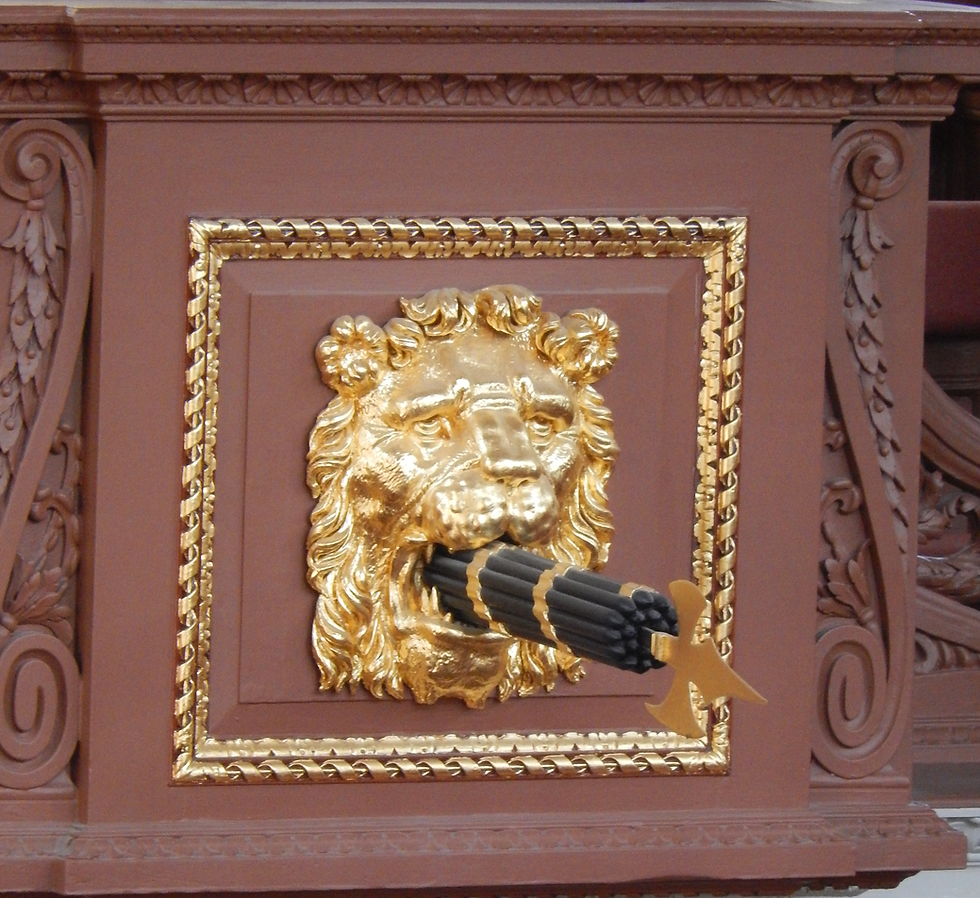
Once you start noticing it, it’s everywhere. Pay attention to political debates, everyday conversations, and even online comment sections. The F-word is there: “That’s fascist! He’s a Fascist! It’s clearly fascism.” A word, an intricate concept, that was once specific to a detrimental political ideology, is now scattered like confetti to describe any group, person, politician, or anyone that we do not like, or that disagrees with our views. However, this word is as misunderstood as it is misused. So what is the true meaning of fascism, and why should we care about the manner in which it is being dissipated?
Etymologically speaking, the word “Fascism” comes from the Latin word “Fasces,” which literally refers to a bundle of sticks tautly tied together. These fasces, usually accompanied by a protruding axeblade, began as a symbol in Ancient Rome with civil servants, also known as lictors, holding them as a symbol of the penal power of the magistrate they were accompanying. The symbol was then reclaimed by Benito Mussolini as an attempt to identify 20th-century Italy with Ancient Rome. Through it he wished to return Italy to its founding principles and its previous glory while asserting his power as the country’s leader. The bound fasces embodied the vision of a tightly intertwined, fused nation that planted the seed for fascism to thrive. Other than the blatantly obvious example of Mussolini’s Italy, few historians also consider Francoist Spain as another example of fascism.
Before WWII, fascism used to be a political movement; some would have called it “just branding”, as it was much less controversial compared to its current negative connotation. Republicans aligned themselves with a republic, Democrats aligned themselves with a Democracy, Socialists aligned themselves with Socialist Parties and the idea of socialism, and Communists aligned themselves with Communist Parties and the communist ideology. Likewise, Fascists’ ideas aligned with the ideas of the fascist party.
“Fascism”, contrary to popular belief, is not just the presence of tyrannical rule; it rather entails a collection of specific ideological elements that shape its meaning. In reference to the political compass, it refers to a far-right authoritarian and ultranationalist political ideology that presupposes the forcible suppression of opposition under a centralised autocracy constructed by a dictatorial leader. It praises political violence as a method of political rejuvenation and aims at achieving autarky through the implementation of protectionism and governmental restrictions. Fascism bases its degree of legitimacy on mass support and prospers in the context of the belief in the natural superiority of a nation, its destiny to rule over all other nations, and the perceived need for racial purity. Additionally, it adheres to the past glories of the nation and creates an aspiration to return to them. Since WWII, very few parties have described themselves as fascist. Still, the fact remains that the increase in the use of this word is exponential.
What about the use of the word online? In the digital waters we are called to navigate, the use of excessive language is rewarded as it gives the illusion of moral superiority and profound knowledge. The use of words such as “Fascism” is yet another foolish way for journalists or anyone with a platform to grab the attention of the average person while doom-scrolling. The stronger the language used, the more engagement each post receives on social media. Algorithms favour simplicity, with a balanced critique not receiving nearly as many clicks as one that uses “big words” such as “Fascism”. Memes and short-form content created to cater to the shortened attention span of the average individual transfer the meaning of complex concepts into short headings or slogans. And through this process, from its previous heavy connotation, fascism has become an aesthetic; For many, it means “villain energy”, military uniforms, and waving red flags.
Once you categorize everything under one term, this term loses its meaning; This is because it is no longer a way of distinction from other terms. Indicatively, for art, considering everything art would mean that the word would lose its specific meaning as it would no longer allude to a specific quality. With both the right and the left weaponizing the term “Fascism”, and with online users reducing a lesson of history into a hashtag, it has consequently lost its true meaning. We are no longer alarmed when we encounter it online or in conversation. This lack of critical awareness is the price we, and our society, pay for the disappearance of nuance in our everyday interactions. With everything becoming fascism, fascism in turn becomes nothing.
There is still hope, though. We can refill the word with meaning again, in the same way we emptied it before. Reclaiming the word requires coming to a consensus as a society. It foresees deeming accuracy in writing not simply as an academic responsibility limited to scholars, but rather as our buffer zone against political manipulation and awareness. The use of politically accurate language can, and should, become our accepted norm through education and the acquisition of accurate political knowledge. Only then will we be able to question narratives in the context of becoming citizens whose conscience can strengthen democracy.
The words we use shape how we see the world. It would therefore be irrational to undermine the power of precision in how these words are chosen. The overuse and misuse of words such as “fascism” could fuse real danger with background noise. Therefore, it is all of our responsibilities to label things as they are. Fascism is not a hashtag, an aesthetic, or any opinion you do not agree with- it is the systemic framework that silences these opinions, as well as those of your own; and unless we remind ourselves of this word’s true meaning through a simple change in our everyday use of language, we might come to be reminded of it in harsher ways.


J'ai passé quelques heures sur Pokiig la semaine dernière dans la section puzzle. Certains jeux m'ont accroché plus que je ne le pensais — je me disais encore un niveau et j'ai fini par perdre la notion du temps.
Great work!!